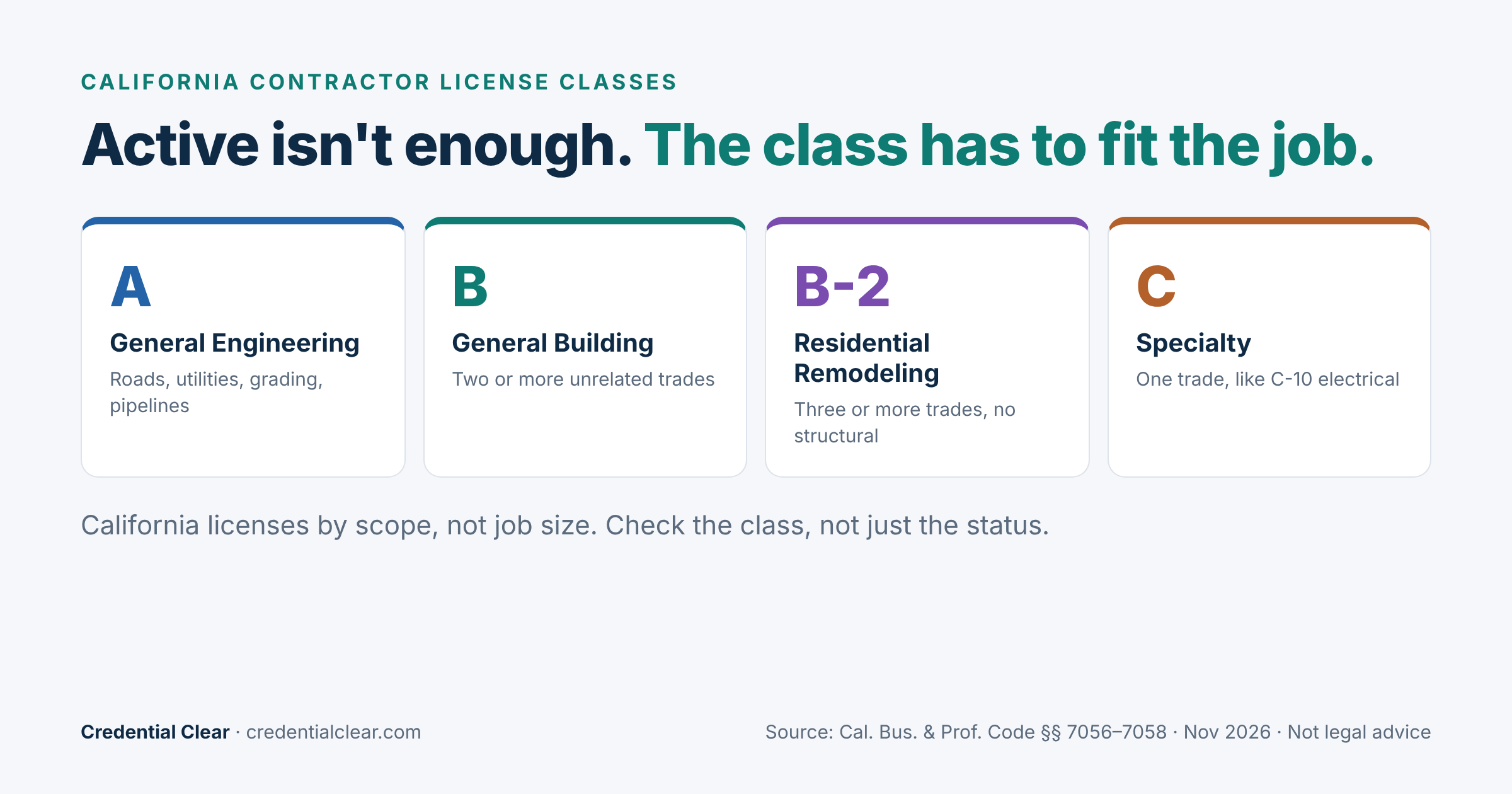
Short answer: California licenses contractors by classification, not by project size. Class A covers general engineering, Class B covers general building on jobs that need two or more unrelated trades, B-2 covers residential remodeling, and the C classes cover single trades like C-10 electrical or C-36 plumbing. A sub with an active license can still be unlicensed for your job if its classification doesn't match the work.
General information, not legal advice.
The four groups
| Class | Covers | Statute |
|---|---|---|
| A — General Engineering | Fixed works that need specialized engineering knowledge: roads, bridges, utilities, grading, pipelines | Bus. & Prof. Code § 7056 |
| B — General Building | Structures, when the job needs at least two unrelated trades | § 7057 |
| B-2 — Residential Remodeling | Improvements to an existing residential wood-frame building, with three or more unrelated trades | § 7057.5 |
| C — Specialty | One trade: C-10 electrical, C-20 HVAC, C-36 plumbing, C-16 fire protection, C-39 roofing and so on. C-61 Limited Specialty has its own "D" subcategories | § 7058 |
The CSLB license record lists every classification the business holds. That line matters more than the word "Active."
The B license is not a do-anything license
GCs and facilities teams often assume a Class B contractor can take any building job. The statute is narrower:
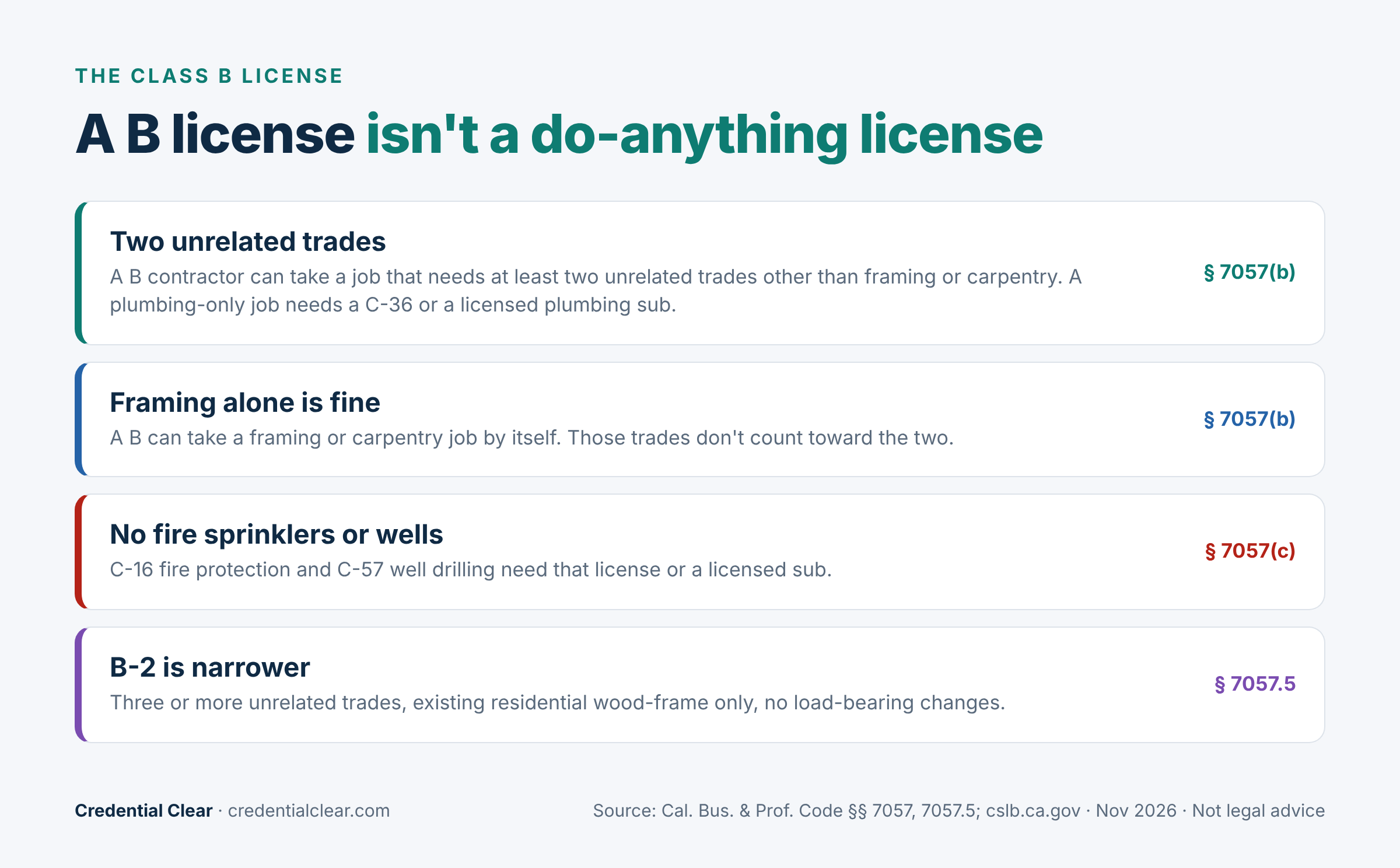
- Two unrelated trades. A B contractor can take a job that needs at least two unrelated trades other than framing or carpentry. A B contractor bidding a plumbing-only job needs the C-36 or a licensed plumbing sub (§ 7057(b)).
- Framing and carpentry are the exception. A B can take a framing or carpentry job on its own, but those trades don't count toward the two.
- Fire protection and well drilling are carved out. A B contractor can't contract for C-16 fire protection or C-57 well drilling work without that license or a licensed sub (§ 7057(c)).
- B-2 is narrower still. No load-bearing structural changes, and the contract must include three or more unrelated trades (§ 7057.5).
Working outside your classification is grounds for CSLB discipline (§ 7117.6). For a GC or owner, the practical risk is a sub doing work its license doesn't cover, on your job.
Where the mismatch shows up
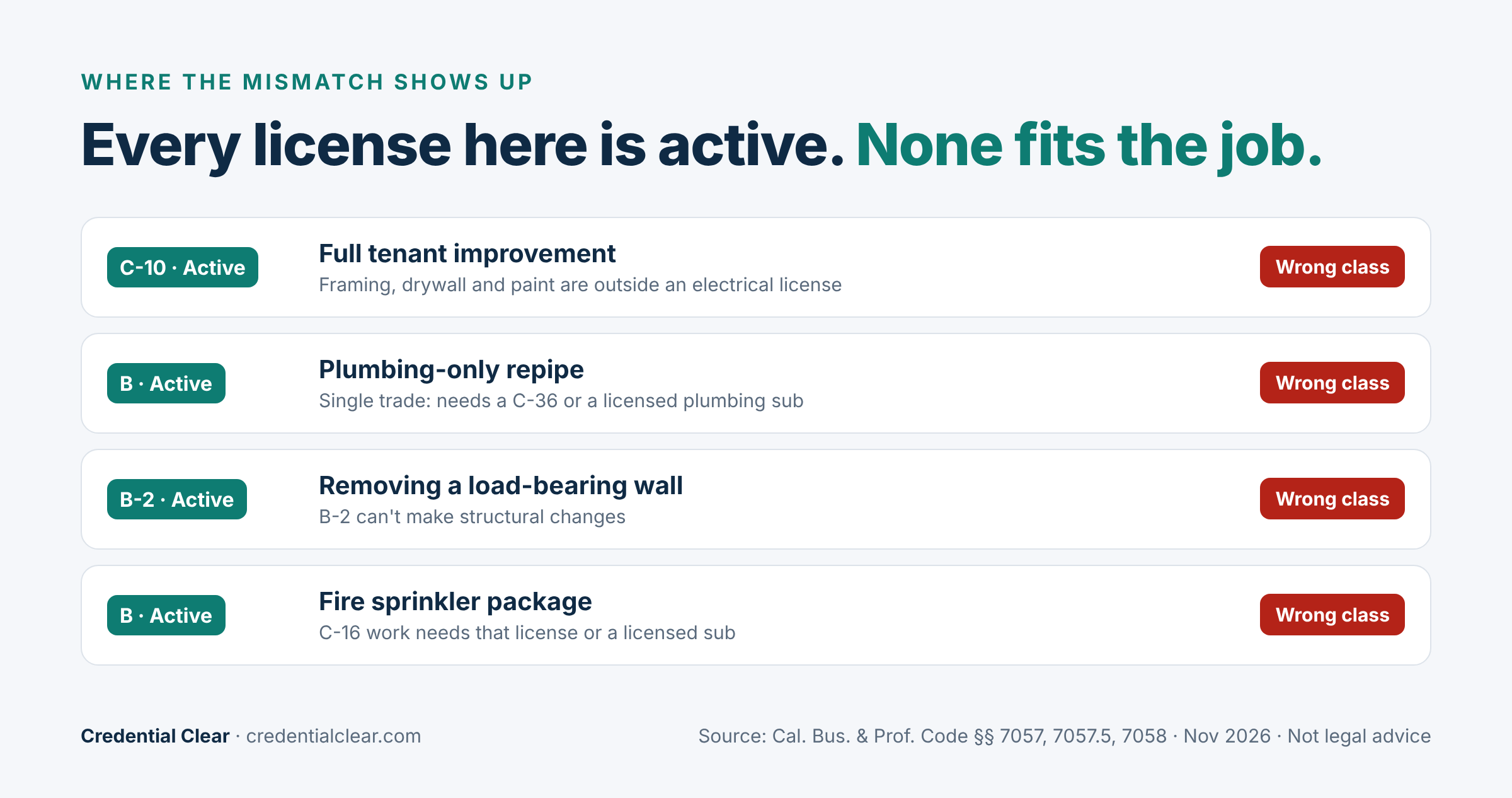
- A C-10 electrical contractor takes a full tenant improvement with framing, drywall and paint.
- A B contractor takes a plumbing-only repipe with no C-36 and no plumbing sub.
- A B-2 remodeler removes a load-bearing wall.
- A B contractor bids a fire sprinkler package without a C-16 sub.
Each one has an active CSLB license. Each one is the wrong license for that scope.
What to check on the CSLB record
- Status: active, not suspended or expired.
- Classifications: the trades on the record cover the scope in your subcontract.
- Bond: a $25,000 contractor bond is required for an active license (§ 7071.6). The record shows the bond company and date.
- Workers' comp: a policy, or an exemption. A sub with employees and an exemption is a red flag. If coverage lapses, the license is suspended on that date (§ 7125.2).
- Name and qualifier: the business name matches your contract, and the qualifier is still on the license.
Then check again. Classifications get added and dropped, and bonds and comp lapse mid-job.
Two California credentials that aren't on the CSLB record
- Electricians. People doing electrical work for a C-10 contractor must hold a state electrician certification from the Department of Industrial Relations (Cal. Labor Code § 108.2). The C-10 license covers the company, not each electrician.
- Pest control. Pest control companies are registered with the Structural Pest Control Board, not CSLB (Bus. & Prof. Code § 8550). A pest vendor won't show up in a CSLB search.
How CredentialClear helps
Search a California sub by license number, business name or owner's name. The result shows the CSLB status, classifications, bond (surety, amount, any cancellation date), workers' comp (carrier and expiration, or exempt) and the qualifier, with lapsed coverage flagged. The same search also checks DIR electrician certifications (by certificate number) and the Structural Pest Control Board.
Add the sub to your roster and it's re-checked automatically, daily, weekly or monthly. When the status changes, including a suspension, you get an email. For general liability, send a COI request link and CredentialClear reads the certificate for you.
Start your free trial (15 days, everything included, no credit card to start) · California page · Related: California's mid-project risk after prequalification · The $1,000 rule for vendors
FAQ
What are the main contractor license classes in California? Class A general engineering, Class B general building, B-2 residential remodeling, and the C specialty classes for single trades (Bus. & Prof. Code §§ 7056–7058).
Can a Class B contractor do electrical or plumbing work? As part of a job that needs at least two unrelated trades, yes. For a single-trade job, the B contractor needs that C license or a licensed specialty sub (§ 7057).
Does California limit project size by license type? No. California licenses by classification (scope), not by dollar limit. North Carolina, by contrast, caps general contractor licenses by project size.
Where do I see a contractor's classifications? On the CSLB license record, along with status, bond and workers' comp.
Can a B contractor install fire sprinklers? Not without a C-16 license or a licensed C-16 sub (§ 7057(c)).
Do electricians need their own license in California? Electricians working for a C-10 contractor need a DIR electrician certification (Cal. Labor Code § 108.2). The contractor's C-10 license alone doesn't cover them.
Not legal advice.